![Northam Platinum Limited [logo]](i/logo.gif)

- Print this page
- This page as PDF (239KB)
Operations review
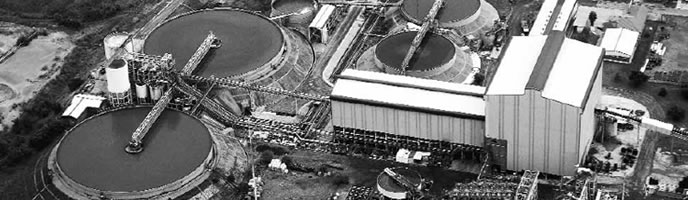
Zondereinde mine
| Ownership | Wholly-owned by Northam Platinum Limited |
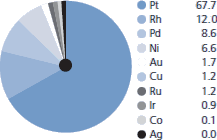
| Location | Northern part of the western limb of the Bushveld Complex in Limpopo Province; adjacent to the Anglo Platinum’s Amandelbult operation |
| Access and infrastructure | Well-established infrastructure: tarred roads, railway, water and power |
| Project extent | 7 625 hectares; strike length of 8km |
| Reserves | 7.5Moz (3PGE+Au) |
| Resources | 25.8Moz (3PGE+Au) |
| Life of mine | 18 years |
| Operations | Underground mining operations on the Merensky and UG2 reefs between 1 200 and 2 200 metres in depth |
| Underground equipment driven by hydropower. | |
| Surface operations include a Merensky and UG2 concentrator plant, a smelter and base metals removal plant (BMR). | |
| Production profile | Steady state output of approx 300 000oz (3PGE+Au) annually |
| Precious metals refining | Performed by WC Heraeus GmbH (Heraeus) in terms of toll-treating agreement |
| Marketing | In-house, independent marketing to established global customer base |
| F2010 capex | R231.5 million |
| F2011 capex (estimate) | R340 million |
| F2010 cash costs | R215 900/kg (3PGE+Au) |
People, health and safety
At the end of June F2010, a total of 8 678 people were employed at the Zondereinde mine (6 529 permanent employees and 2 149 contractors). In spite of the depressed global economic environment, no employees lost their positions owing to any associated restructuring or retrenchment during the period.
Maintaining the company’s BEE credentials in the year was marked by progress in employing and developing historically disadvantaged South Africans (HDSAs). At the end of F2010, 32% of management positions were filled by HDSAs (F2009:25%) with women making up 6% of the workforce compared with 4% during F2009.
Ensuring the safety of employees and contractors is a primary area of focus for the company and takes precedence over any production objectives. A critical objective has been to develop and instill a shared duty of care between employees at all levels in the company.
Key indicators
Safety
- One fatal accident in F2010
- LTIIR1 – 0.82 per 200 000 hours (F2009: 1.02)
- RIIR2 – 0.52 per 200 000 hours (F2009: 0.63)
- FIIR3 – 0.01 per 200 000 hours (F2009: 0.05)
- 2 million fatality free shift milestone reached in February 2010
- 1 881 shifts lost owing to occupational injury
- 17 days lost owing to safety in stoppages
Health
- 10 764 medical surveillance examinations in F2010
- two compensable cases of noise induced hearing loss (NIHL)
- 127 new cases of tuberculosis
- 1 840 voluntary counselling and testing (VCT) encounters – increase of 79% year on year
- 434 employees on anti-retroviral therapy (ART)
1 LTIIR – lost time injury incidence rate – resulting in one to 13 days’ absence from work
2 RIIR – reportable injury incidence rate – resulting in 14 or more days’ absence from work
3 FIIR – fatal injury incidence rate
| Merensky reef | F2010 | F2009 |
|---|---|---|
| Development metres | 8 864 | 8 071 |
| Square metres mined | 201 569 | 201 014 |
| Tonnes milled | 1 002 208 | 1 050 404 |
| Head grade (g/t 3PGE+Au) | 5.9 | 5.8 |
| PGMs in concentrate produced (kg) | 5 094 | 5 164 |
| Ore reserve availability (months) | 20 | 20 |
| UG2 reef | F2010 | F2009 |
|---|---|---|
| Development metres | 2 694 | 3 770 |
| Square metres mined | 166 129 | 160 555 |
| Tonnes milled | 1 036 017 | 1 054 687 |
| Head grade (g/t 3PGE+Au) | 4.6 | 4.4 |
| PGMs in concentrate produced (kg) | 3 917 | 3 835 |
| Ore reserve availability (months) | 24 | 19 |
| Combined reefs | F2010 | F2009 |
|---|---|---|
| Development metres | 11 558 | 11 841 |
| Square metres mined | 367 698 | 361 569 |
| Tonnes milled | 2 038 225 | 2 105 091 |
| Head grade (g/t 3PGE+Au) | 5.2 | 5.1 |
| PGMs in conc. produced from u/g mining (kg) | 9.011 | 8.999 |
| PGMs in conc. from other sources (kg) | 988 | 409 |
| Total (kg) | 9 999 | 9 408 |
| PGMs in concentrate purchased | 2 106 | 487 |
The year in review – mining and production
The improved combined average head grade of 5.2g/t (3PGE+Au) compensated for the 3.2% drop in tonnages milled to 2 038 225 tonnes, contributing to a 6.3% increase in total production of metals in concentrate to 9 999kg (321 475oz). Both the Merensky and UG2 head grades improved over the year – the Merensky grade was higher at 5.9g/t owing to minor variations in the relative proportions of Merensky pothole facies mined, while the slightly higher UG2 grade resulted from improved stoping width control, along with mining also focusing on the marginally higher grade western portion of the mine.
The operational performance at Zondereinde remains inextricably defined by development, maintaining a healthy Merensky ore reserve position, the ratio of Merensky and UG2 concentrate fed into the smelter, and control of the mill head grade.
Development issues
The sterilization of the Merensky reef in the eastern part of the mine, a legacy from 2007 and 2008, has continued to put some pressure on ore reserve development in the north western parts of the mine. The structural geological features in this quadrant have presented some difficulties for development, with delays on 3 and 4 levels west occasioned by the 14 line thrust fault which has affected advance rates in the footwall drives and crosscuts.
The advance of 6 and 7 levels west, which have finally transversed the 20 line fissure, will facilitate the connectivity between the northwest and southwest quadrants of the mine. This will ultimately result in more efficient ventilation flow, more available face length and improved mining flexibility.
Raises have been established on the west side of the Big John Dyke structure, and development has progressed through the structure on 9 and 10 levels.
Overall development was 10% up on the previous year, but some difficulties remain, which will affect Merensky mining in the short term.
Available Merensky reserves
Given the complex nature of the Merensky reef at Zondereinde a 24 month available reserve position is desirable to migitate risk. The reserve position is affected by the rate of depletion and the rate of replenishment from development. By the end of the financial year the reserve was pegged at 20 months’ availability, up from 19 in the first half of the year, with 10 new raise lines brought on line. The challenge now lies in maintaining this trend and restoring the ore reserve availability to the optimal 24 months.
Merensky/UG2 tonnage ratio
The Merensky mining difficulties on the upper levels of the mine impacted the balance of the feed to the smelter. At the end of the first half of the year the ratio was at 0.87:1; more focus on Merensky mining, in the second half helped to improve this to 0.96:1.
Mill head grade
The average mill head grade was 2% up on the previous year owing to UG2 mining in the marginally higher grade western part of the mine, the balance of Merensky mining swinging to higher grade reefs, and improved mining control. Going forward this is likely to be maintained owing to the augmentation of the UG2 data set on the east side of the mine, which indicates grades higher than initially estimated, allowing an increase in the UG2 reserve grade to 4.5g/t.
Expansion project
Progress on the development of the service decline and associated infrastructure for the 18 level expansion project has been somewhat slower than anticipated owing mainly to delays in introducing larger trackless vehicles which required some work to accommodate them. However, development to reef on 14 and 15 levels has continued as planned with stoping currently taking place on 14 level.
Metallurgical operations
The concentrators, smelter and base metals removal plant have operated satisfactorily within their design parameters.
Smelting operations, which were temporarily suspended on 17 May 2010 following an incident in which the electrostatic precipitator was damaged, were restarted on 9 June 2010 following the installation of a temporary bypass around the precipitator. The permanent repair is expected to be completed by the end of October 2010.
The purchase of 2 106kg of concentrate for toll-smelting during the year contributed to the 18.8% increase in metal sales for the year to a record 12 313kg or 395 879oz.
Costs
Cash operating costs per tonne milled increased by 18.7% as a result of the 17.0% increase in total operating costs and a 3.2% decrease in tonnes milled. Cash operating costs per kilogram produced however increased by a slightly more modest 8.1% owing to the marginally higher grades achieved, improved recoveries in the UG2 concentrator and the previously reported 480kg gain from the treatment of secondary material.
Capital expenditure
Capital expenditure at Zondereinde absorbed R231.5 million, with main capex items comprising the deepening project amounting to R91 million. Capital expenditure for F2011 is likely to be R340 million with the deepening project and accellerated development accounting for about R175 million.
Into F2011
Production will continue to be affected by the difficulties associated with Merensky mining, although the focus will remain on control of the mill head grade and improving the availability of the ore reserve. Key to this is the connectivity between levels on the west side of the mine and the advancement of the deepening project in the medium and longer term.
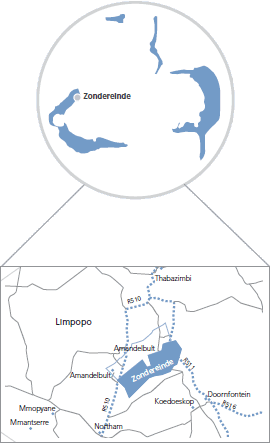
Zondereinde prill splits (combined Merensky and UG2) (%)
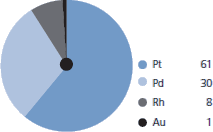
Contribution to revenue by metal (%)
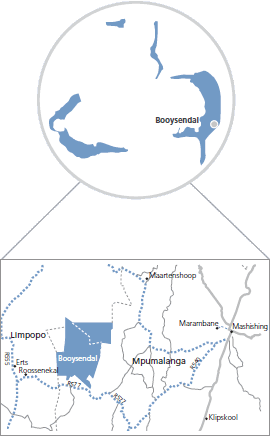
Booysendal project
| Ownership | Wholly-owned by Northam Platinum Limited |
| Location | Eastern limb of the Bushveld Complex in Mpumalanga Province; adjacent to the Everest and Mototolo operations. Closest town is Lydenburg |
| Access and infrastructure | Tarred road access from Lydenburg; new private road being constructed across the Der Brochen property |
| 16MW power secured from Anglo Platinum for construction; | |
| Eskom approved 20MVA | |
| 5MVA self generation | |
| 7Ml of water secured for start-up | |
| Project extent | 15 170 hectares; strike length of 14.5km |
| Reserves | 3.0Moz (3PGE+Au) |
| Resources | 103.3Moz (3PGE+Au) |
| Life of mine | 50 years and beyond |
| Project status | Board approval granted for project. Feasibility study and optimisation exercise completed; early infrastructural work and boxcut construction in progress on site |
The year in review
Northam’s feasibility study on the Booysendal project was completed on schedule at the end of September 2009 and confirmed the modular approach to developing the project, with initial work to focus on the UG2 reef. This was followed, immediately thereafter by an optimisation exercise which has pointed to a larger project than initially envisaged, yielding an enhanced return, and:
- Accelerating the start-up of production, with the concentrator commissioning planned for January 2013, three months ahead of the initial schedule
- steady state mining envisaged for February 2014
- improved design capacity producing 187 500 ROM tonnes/month
- Anticipated production of 162 000oz (3PGM+Au)
- Cash costs of R455/t milled, compared with R505/t indicated in the base case
The more detailed optimisation study has resulted in a review also of the capital expenditure, with peak expenditure required in 2012. The intial capex number of R3.1 billion has been adjusted in line with a scaled up operation, and also reflects the effects of inflation.
At full capacity the revised mine design and higher rate of production are anticipated to result in electricity consumption at peak demand times exceeding the ESKOM approved 20 MVA. These peaktime shortfalls will be filled in by self-generated power of 5MVA on site. This arrangement is anticipated to persist until ESKOM is able to supply additional power, currently estimated to be by 2015.
The revised design also makes provision for an energy management system and the introduction of energy recovery strategies. Orepass capacity has been improved in the mine design which will minimise the requirement for decline conveyors to run during peak shift times. In addition, cycle efficiencies and optimised equipment selection will maximise output in each section, and at the same time reduce the number of sections required to operate.
Capital expenditure
A total of R145.5 million was spent on the Booysendal project over the year. The main capex items were the early works programme, establishment of infrastructure such as access routes and temporary water supply. As the project gains momentum the capex spend will increase substantially and peak during the 2012 financial year.
Into F2011
With the granting of the EMP approval shortly before going to print, the construction and development work will gain momentum, with the on-reef boxcut and preparatory earthworks for the reverse decline continuing. Decline development is expected to start in January 2011.
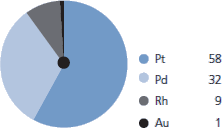
Booysendal prill splits (UG2) (%)
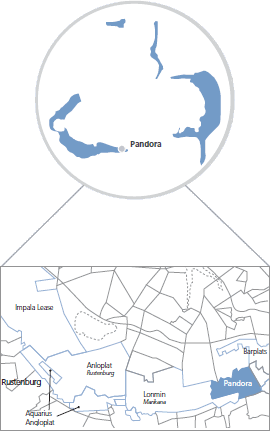
Pandora joint venture
| Ownership | Lonmin: 42.5% |
| Anglo Platinum:42.5% | |
| Northam: 7.5% | |
| Bapo Ba Mogale Mining Company: 7.5% | |
| Location | Western limb of the Bushveld Complex on certain portions of the farms Hartebeespoort, Roodekopjes and Uitvalgrond near Brits in the North West Province adjacent to Eastern Platinum Mine (EPM). |
| Access and infrastructure | Existing infrastructure at EPM has been utilised to gain quick access to the Pandora Mine. |
| Reserves (total) | 1.3Moz (3PGE+Au) |
| Resources (total) | 21.3Moz (3PGE+Au) |
| Resources* | 1.6Moz (3PGE+Au) |
| Reserves* | 0.1Moz (3PGE+Au) |
| Life of mine | 30 years and beyond |
| Project status | Pre-feasibility completed; stand-alone mine of 240 000tpm being considered. |
*attributable to Northam
The year in review
The Pandora Joint Venture (Pandora) continues to produce on a relatively small scale from Lonmin’s Eastern Platinum infrastructure. Lonmin purchases 100% of the ore produced from Pandora. For the nine month period ended 30 June 2010, Pandora underground production produced 33 658 saleable oz of total PGMs, some 52% lower than the prior year due to the closure of the Pandora opencast operations during 2009. Pandora contributed R12.4 million in revenue to Northam in the year ended 30 June 2010.
Into F2011
A feasibility study for a 240 000 tonne per month underground mining operation has been completed and is in the process of being reviewed by the joint venture partners.
NORTHAM ANNUAL REPORT 2010