![Northam Platinum Limited [logo]](i/logo.gif)

Chief executive’s review
The past financial year has been a busy one, characterized by transition on many fronts. The ongoing global economic recession has meant that neither the demand for resources nor metal prices have yet recovered to pre-financial crisis levels. This has been a less than ideal background to the geological, mining and cost challenges we have had to face in the past year at Zondereinde, while also completing the Booysendal feasibility study and optimisation exercise, as this project rapidly reaches the execution phase.
Our emergence from single asset status to a company with a healthy, geographically diversified asset portfolio has been both exciting and challenging. The challenges have mostly been in scaling up human capital and expertise, while modifying existing support systems to deal with a transformed company structure. For a company like Northam, where we have always guarded against corporate excess and traditionally run a very lean ship – this has sometimes required something of a paradigm shift. Nevertheless, we have made good progress in expanding and integrating our financial, IT and human resource systems. We are fortunate that so many of the systems are already in place and well managed at the Zondereinde operation; with Booysendal beginning to run off these systems we will in time be achieving the economies of scale which would assist in gaining efficiencies and moderating unit cost increases.
Safety
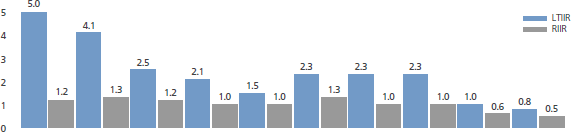
At Zondereinde mine safety remains the most critical focus area and one that remains fundamental to the sustainability of our business. Our approach to safety is underpinned by the simple maxim of avoiding injuries, of any kind, no matter what the severity. This fairly simple exercise in self-preservation applies equally in any human endeavour, and in time has to translate into a reduction in injuries and accidents, and in turn it must also result in a reduction in fatalities. Over the past 10 years we have seen a very encouraging downward trend in injury rates. Year on year both our reportable and lost time injuries were some 20% lower; however, we are now reaching the stage of diminishing returns – in other words we can no longer expect such quantum improvements. So the challenge will lie in guarding against complacency, sustaining a culture of continuous safety awareness and maintaining these levels.
Sadly, the excellent efforts of management and employees alike in achieving two million fatality free shifts during the year were overshadowed by the tragic loss of Mr Sebenzile Ketile in May in a drilling accident, and after the year end that of Messrs Cossa and Chithango in a fall of ground incident.
Injury incidence rates per 200 000 man hours

Glyn Lewis, Chief executive
Operational performance
Operationally Zondereinde fared well under trying circumstances. Total production was 6.3% higher at 9 999kg despite the loss of 22 production shifts and persistent difficult Merensky mining conditions. The legacy of the sterilization of the Merensky resource on the eastern side of the mine continued to impact ore reserve development. Some delays in the northwest quadrant of the mine were experienced in the first half of the year as some structural features were negotiated. Since then there have been varied levels of success but inconsistent ground conditions continue to impact the creation of new mineable face length.
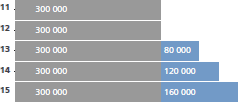
There is progress on the 18 level deepening project, which opens up more conformable Merensky reef, and where, with each additional level, we add two years to the operation’s life. Importantly, though, Zondereinde’s resilience lies in its grades, the highest in the industry, and excellent recoveries throughout the metallurgical process. As a mature mine, Zondereinde should, with the development of the 18 level expansion project, continue to produce around 300 000oz per annum for the remainder of its 18 year life, which is calculated on the availability of Merensky reef.
We have in the past indicated our intent to leverage our metallurgical capacity and to create downstream beneficiation opportunities. For the first time this year, after the smelter rebuild in F2009, purchased concentrate has made a significant contribution of 17.4% to our sales volumes. This purchased material, which enters our metals to market stream, does not, as yet, yield large margins for us, but its benefits are real and they are twofold – in that it helps to provide some diversification and balance to our smelter feed, and adds to the critical mass in volume to provide feed for the Heraeus precious metals refinery in Port Elizabeth. Obviously we would like to forecast similar quantities of purchased concentrate in the year ahead, but the quantum will largely be determined by the mix of our own on-mine production, and the availability of concentrate from our suppliers.
The cost performance at Zondereinde was disappointing. The 17.0% increase in operating costs is much higher than inflation, and reflects the increases in our mining input costs, especially those of labour, steel and power. It’s fair to say that, in the medium term, unit costs should improve once we have negotiated our way through the underground production restrictions and get to draw some advantage from the economies of scale represented by the additional tonnages associated with the development of the decline. For now though costs remain under pressure and threaten to erode our operating margin –the current strike action bears testimony to the unrealistic demands from labour, which have also been fuelled by the recent protracted public servants’ strike.
In pursuit of improved disclosure and to give investors a better sense of the management of those costs we do have control over, we have, in this report, attempted to provide a more transparent cost breakdown in the financial review, and in the notes to the financial statements (PDF - 118KB).
Earnings year on year were largely flat despite the increased sales volumes and reflect the effect of higher investment income and a lower tax charge. Given Booysendal’s imminent capital requirements, and in line with what we have cautioned in the past, we have increased our dividend cover to 4.5 times for the year, resulting in a dividend of 40 cents per share for the full financial year. This is unlikely to be any more generous in the years ahead.
The Booysendal project remains on track, with an estimated capital expenditure of R3.6 billion approved by the board in April 2010. As recently as the second week of September this year we received notice of the approval of our environmental management programme (EMP); athough there are still some ancillary environmental permitting approvals outstanding, we are now in a position to move forward on the construction and development phase at Booysendal. During the year, capital expenditure of R340 million was allocated to an optimisation exercise to extract further value from the project, and an early works programme to allow for infrastructural development on site. The optimisation study has suggested a more robust project with output levels of 162 000oz (3PGM+Au) per annum and an accelerated timeline, with first production anticipated in January 2013. There cannot be many PGM companies which have the prospect of such a step change in production growth. Given that the availability of power remains key to the successful development and operation of new PGM projects, we believe the work we are doing with Jubilee Platinum plc (Jubilee) in determining the viability of establishing a ConRoast smelter facility in Middelburg in the Mpumalanga provice, which has its own secure and relatively inexpensive power supply, could give Booysendal a further competitive advantage in the sector. This gives us some smelting optionality too, as we continue to diversify and grow our production base.
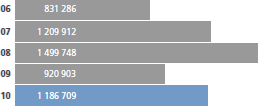
Shareholders have been anxious for us to provide more certainty with regard to our preferred method of funding the development of the Booysendal mine. This is largely owing to the delay in the unbundling process of our major shareholder, Mvelaphanda Resources (Mvela Resources) and the growing unlikelihood of a successful rights offer to fund Booysendal. We have made good progress in exploring funding alternatives that match our risk-averse nature on the one hand but which, on the other hand, also give us sufficient flexibility in a fairly uncertain economic environment. Taking into account our current cash position of R1.1 billion, expected future operating cash flow from Zondereinde, and the timing of the capital expenditure requirements to fund the development of the Booysendal mine, with peak funding only required in the 2012 financial year, we anticipate a combination of flexible bank debt and a convertible bond to fund the shortfall. By 2011 when we need to start raising this funding, we would expect some improvements in the debt and equity markets.
Integrated reporting
In F2010, we took a number of significant steps towards the integration of sustainability management and reporting into the core operation of our business. An important part of this has been a consideration of what sustainability means to the business, and how we reflect this in our reporting.
Sustainability for Northam implies the sustainability of the business as a whole, with environmental, social and governance (ESG) issues forming an integral part of the way we conduct our business. For us this means:
- the responsible and profitable operation of the Zondereinde mine;
- the responsible and economic development and growth in our assets, primarily through the delivery into production of the Booysendal project;
- and compliance with listing and other requirements so that the company is able to maintain its licence to operate and to attract and retain capital.
In line with this increased air of attention and focus we felt the need to develop an over-arching sustainable development policy, pulling together our vision for the company and the various underlying policies relating to safety and health, environment and community development in place at an operational level. This policy was approved by the board in August 2010.
So, this is our first annual report which seeks to integrate the environmental, social and governance (ESG) performance with the operational and financial results of the group. As we progress towards a fully integrated report, and in pursuit of improving the governance within the company, we have included these ESG indicators in our internal reporting processes, ensuring that there is oversight through the various management reporting structures up to the board sub-committees and board level. Through this process, we are now in a position to start formally reporting on these indicators which are a critical component of the way we do business, and are no longer the ‘poor relation’ in the reporting process. As part of this process we have taken a step further this year in identifying our most significant sustainability issues. These have been included in this report under sustainable development in brief (PDF - 55KB). Reporting on these issues will be found throughout this report, while much greater detail is presented in our ancillary sustainable development report, which is separately published along with the annual report. In this we have provided further detail on the systems and reporting processes we have been implementing steadily over two years in order to identify and report on the material impacts of our business in the medium to longer term.
As our financial reporting has been reviewed by external auditors, so have certain key performance indicators in our sustainability report. This report has been produced in alignment with the GRI’s G3 guidelines and for the first time this year we have declared a B+ level of reporting.
Our inclusion in the Socially Responsible Index (SRI) of the JSE since 2006 is obviously something which we would like to perpetuate also, as it helps to maintain a profile for Northam amongst an ever more discerning shareholder community.
Governance and King III
With the advent of the King Code of Corporate Governance Principles (King III), and the more stringent governance requirements, we commissioned an independent review of our compliance with these new recommendations. Specifically, this review examined current practices, and identified and analysed the gaps that exist between current practice and King III. We are currently considering the actions recommended by the independent review, and remain committed to implementing King III in the near to medium term.
Climate change and environmental management
It is an honour for us to be recognised by the Carbon Disclosure Project (CDP) as a leading reporter on the risks and opportunities presented by climate change. This follows on the second year of our participation in the process and is something we manage rather intensively through the various established energy conservation initiatives at the Zondereinde operation. As a primary producer of PGMs, known for their green qualities in reducing noxious gases in emissions, and as a component metal in the manufacture of fuel cells, the threat of climate change presents for us an opportunity in sustaining demand for our products. We also participated, on a voluntary basis, in the newly-established CDP water project.
Water management is obviously a critical environmental issue for us and we are committed to continuous improvement in the management and reporting strategies in the future. At Zondereinde we are at an advanced stage of adopting the ISO14001 environmental management system, having already completed the first auditing phase. Sadly, the wage strike has interrupted our second phase audit, which was planned for September.
Transformation
An important consideration for any mining company in South Africa is of its black economic empowerment (BEE) status. The interconditional Booysendal transaction, concluded in 2008 with Anglo Platinum Limited (Anglo Platinum) and Mvelaphanda Resources Limited (Mvela Resources) secured for Mvela Resources a BEE holding of 62.7% in Northam. Mvela Resources’ disposal in April this year, of 12.2% of its Northam holding to Eurasian Natural Resources Corporation plc (ENRC), ahead of its unbundling process could possibly result in a slight decline in our empowerment status. We are conscious of this and remain committed to ensuring that our credentials will be intact by the target year of 2014.
Our transformation initiatives at the operational level, in terms of the Mining Charter targets, have yielded mixed successes. Most challenging have been the targets related to the employment of skilled women and historically disadvantaged South Africans (HDSAs). On the other hand some modest success has been achieved in the area of procurement, where the systems and supply chain management policies we have implemented have helped to grow our procurement spend from these vendors over time.
During the year we embarked on a process of reviewing and auditing the quality and accuracy of the data we generate in terms of Charter compliance. This process has been helpful in determining our levels of compliance and also assists in developing processes and practices to ensure the achievement of the targets in our Social and Labour Plans (SLPs).
Markets
Our markets have shown some encouraging signs of recovery after the doldrums of late 2008 and 2009. This has translated into renewed stability and growth in PGM applications, stimulating a price recovery. In the final quarter of the financial year in fact, the dollar price for Northam’s basket of metals (3PGM+Au) reached levels of just below US$1 400/oz.
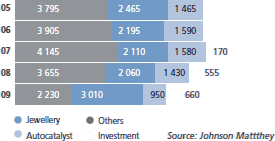
This was after the dramatic impact on the autocatalyst sector as vehicle sales slumped and demand for platinum, palladium and rhodium fell dramatically during the course of 2009. Platinum offtake in particular fell to levels not seen since 2000. A range of government-backed incentive schemes met with some success in stimulating renewed demand for vehicles in some countries. In China, passenger vehicle production surpassed 8.5 million units during the course of 2009 - 45% up on the previous year. This growth trend appears to have continued throughout 2010 albeit it at a more modest rate.
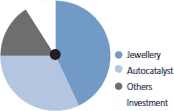
In the jewellery sector demand was remarkably resilient, particularly in China, where sales exceeded a sobering 2 million ounces during 2009. Since then however the upward trend in the platinum price has had a softening effect on sales: year-to-date platinum volumes through the Shanghai Gold Exchange appear to have diminished by some 10% compared to 2009 and the estimated jewellery share of platinum has dropped to 65% from the nearly 80% returned across 2009. The more mature platinum jewellery markets reflect continued recovery as spending power amongst retail consumers in these regions has gradually improved.
PGM demand in the industrial sector was diminished by lower product sales and consequent reductions of metal inventories, leases and new metal purchases. More recently there has been some pick-up in activity as new projects and expansion programmes, most notably in the Middle East and again in China, come on stream. In the electrical sector 2010 has seen a marked recovery in demand for computer and electronic goods, TVs, and cell phones. In the glass sector there has been renewed robust demand for LCD products.
Exchange traded funds (ETFs), a recent feature of the investment sector in platinum and palladium have shown impressive growth recently, enhanced by the authorization and launch of the first US based ETF in January of this year. Current ETF holdings total approximately 990 000oz in platinum and close to 1.7Moz in palladium.
Looking ahead to F2011, the rate of global recovery is likely to be slower than initially anticipated. Already European car sales in July are reported to be some 15% down year-on-year and Japanese manufacturers are cautioning of a likely slow-down in sales as the government motor scrappage incentive scheme expires in September.
Overall however growth in this sector should continue upwards as production and sales in China, Russia, India, South America and South East Asia compensate for slowdowns in Europe, Japan and North America. This is likely to be supplemented by the strengthening of emissions regulations for motorcycles, a popular and affordable transport alternative in China, India and Indonesia.
PGMs remain well positioned to benefit from on-going tightening of emissions legislation and the ever-widening acceptance of the pressures to further enhance environmental management legislation. We also expect the more mature markets for platinum jewellery to perform in line with improving consumer conditions in these regions.
So the future, at least in the short to medium term seems to be underpinned by real support for PGM prices, with a gradual recovery in the US, Europe and Japan and continuing growth in China, albeit at a slowing rate.
Looking to the future
Booysendal brings to Northam an immense growth opportunity, the development of which has put pressure on our resources and, in time, without the appropriate checks and balances in place, potentially also on our balance sheet. In the year ahead we will look at increasing our expertise and management depth for the optimal development of this promising project which, with shallower, quality PGM ounces, will gradually lower the group’s risk profile.
We anticipate that the unbundling of Mvelaphanda Resources Limited (Mvela Resources) will gain momentum in the coming year, the resolution of which will signal a transformed shareholder profile for Northam, along with the strategic stake now owned by Eurasian Natural Resources Corporation (ENRC), which has created some shareholder diversification ahead of the unbundling.
Once we have secured funding, it would not be unreasonable to look at growth beyond Booysendal, while also jealously guarding our BEE ownership levels and thereby securing our continued licence to operate.
With the granting of the EMP for Booysendal, we are now in a position to step up the development of this new mine on the eastern limb.
At Zondereinde it will take 18 months to two years before we are out of the woods and we get to reestablish some mining flexibility. Following the effects of the ongoing acrimonious strike at Zondereinde, now as we go to print already in its third week, it will take a monumental effort from management and employees alike to get close to our 300 000oz production target in the next year.
Glyn Lewis
Chief executive
16 September 2010
Cash and cash equivalents (R000)
Projected production profile (estimate)
Platinum demand by sector 2009 (%)
Platinum demand by sector
2005 – 2009 (Moz)
NORTHAM ANNUAL REPORT 2010