
On many counts, this has been a tremendously successful year for Northam.
Precious metal sales at 362 821 oz, 14% up on the comparable reporting period, contributed to an excellent year for Northam. Combined with the effect of a 38% increase year on year in the metal basket prices received, these record levels contributed to sales revenues of R2.4 bn, some 54% higher than the previous reporting period.
At the operating level steady progress has continued, with a 25% increase in development metres, the successful negotiation through and advancing beyond the 20 line fissure on four levels, capital development to access 1 level, and the deepening project to 14 level. Overall tonnages milled were 7% higher year on year reaching more than 2.3 million tonnes. Good grade control was maintained, with an average combined head grade of 5.5 g/t recorded over the year, resulting in Northam's best ever production levels of 361 599 oz.
Notably, rhodium production increased by more than 39% to 762 kg (24 508 oz) and palladium production was 12% higher at 3 428 kg (110 215 oz), reflecting an increase of almost 23% in tonnage milled from the more conformable UG2 reef. Platinum production increased by more than 8% to 6 826 kg (219 449 oz).
The performance of the metallurgical plants continued to improve during the year. A key contributor to this performance was the external sparger column cell introduced as a final concentrate cleaner which has increased UG2 recoveries from 79.8% in F2004 to an average 83.2% this year, and has also had the effect of reducing the total chrome content of the concentrate significantly. By year end recoveries had increased to 85%.
The metal prices realised by Northam in the year under review were nothing short of remarkable. The average basket price realized totalled R189 286/kg compared with R137 517/kg in the previous year, an increase of almost 38%, reflecting largely the higher US dollar prices for our basket of metals, and, to a lesser extent, the effect of the slightly weaker South African currency. The average exchange rate during the year was R6.41/US$ - 3.2% weaker than the previous year.
Costs were well contained year on year, benefiting also from the higher volumes. Unit cash operating costs were 0.5% lower at R109 677/kg, or $534/oz., while at the rand per tonne milled level good cost control was also evidenced with an increase of only 3.3%.
Northam continues to be highly cash generative, with healthy cash reserves of R831 million at the end of the reporting period. Profit attributable to shareholders climbed sharply to R703 million, up 183% year on year. In line with our track record of returning excess cash to shareholders, a final dividend of 165 cents per share was declared in August. This, together with the interim dividend of 115 cents per share declared in February and paid in March this year, brought the total dividend for the year to 280 cents per share, a creditable 300% higher than the total of 70 cents per share in F2005.
Northam has benefited both from the spectacular metal prices during the reporting period, and from the relative increase in rhodium output, emanating from our thrust to push output from the UG2 reef, which has a higher rhodium content. Tonnage milled from the UG2 reef was 23% higher than the previous year. Year on year, the average US dollar price received for rhodium was 132% higher at US$3 107/oz, being a significant contributor to the higher average basket price received of $918/oz (F2005: $686/oz)
Another feature of the market for us was the revenue contribution from other metals, as by-products of PGM mining, which rose by 66% to R65 million (F2005: R39 million). This largely reflects the surge in the price of copper, for which we realized an average price of $4 571/tonne, 57% higher year on year, and which after year end had reached levels of $8 000/tonne.
Platinum contributed 61% (F2005: 66%) of Northam's revenue in the period under review. The platinum market, of course, continued to enjoy enormous strength, the price ranging from a low of $860/oz to a high of $1 331/oz. Autocatalyst demand was the key driver, itself underpinned by continuing demand for diesel vehicles, particularly in Europe, strong growth in vehicle sales in China, and the introduction and increasing prominence of diesel particulate filters and retro-fit systems. Predictably, demand from the jewellery manufacturing sector has softened, reflecting some resistance to the price and some market penetration by other white metals, but perhaps not to the extent anticipated. In both the specialist glass manufacturing and electrical sectors, there has been significant growth.
Palladium contributed 8% (F2005: 8%) of Northam's revenue, the price ranging from a low of $172/oz to a high of $404/oz. The palladium market, compared with that of platinum, was less favourable, reflecting over-supply and lower demand from the autocatalyst sector due to technological advances that allow lower palladium loadings for gasoline vehicles. Palladium jewellery made significant gains in China, in response to the promotional efforts of the newly-formed Palladium Alliance International. Speculator interest and steady demand for the metal in the dental and electronics sectors were positive factors influencing the market.
Rhodium, a 20% (F2005: 12%) contributor to Northam's revenue, was a surprise performer, the price ranging from a low of $1 790/oz to a high of $6 250/oz. Burgeoning demand from the specialist glass manufacturing sector, growing autocatalyst demand driven by higher rhodium loadings to meet tighter NOx emission controls, forward purchases in the autocatalyst sector and lease buy-backs in the industrial sector all contributed to a widening gap between supply and demand.
Nickel contributed 8% of Northam's revenue. The nickel market was characterised by significant price volatility, the price rising to more than $23 000 per metric tonne in May of the reporting period. A key contributor was the massive increase in stainless steel capacity in China.
Looking ahead, demand for Northam's basket of metals is likely to remain strong.
There is a likelihood that the gap between platinum supply and demand, which has been narrowing, may widen again as some new projects may begin to experience delays in delivery. In South Africa particularly, contributing factors to such delays are likely to include a shortage of required skills, and glitches in the process of converting mining rights from 'old order' to 'new order', in terms of the new minerals legislation. In view of this, and even greater autocatalyst demand issuing from pending tighter emission controls in the United States and Europe, any substantive, sustained decline in the platinum price is unlikely.
Prospects for the palladium market are likely to be less exciting. Supply is likely to continue to exceed demand, making speculator sentiment uncertain. Indications are that platinum and rhodium will probably remain the metals of choice in autocatalyst applications, but there is encouraging evidence that palladium will gain further 'shine' as a jewellery medium.
There were some indications towards year end that supply and demand for rhodium were moving more into balance and that the price was beginning to stabilise as a consequence. This is a trend that may well continue as tighter economic conditions globally temper both demand for what in many parts of the world are still luxury items, driving specialist glass demands, and for the metal as jewellery.
With respect to nickel, demand is likely to remain strong but prices should soften from their recent, unprecedented highs.
With deep regret, we report that four employees died in work-related incidents during the year under review, three in a single underground blasting accident in February 2006.
On a more positive note, we are pleased to report that the total number of injuries was 30% lower year on year, and the achievement by the mine of one million fatality free shifts on 14 August 2006 indicates that the various initiatives which collectively comprised the 'back to basics' approach we alluded to last year have borne some successes.
To address potentially dangerous behaviour in the underground working environment – the cause of 80% of accidents – the recent introduction of 'crack squads' to monitor and remediate through appropriate coaching in the workplace has been welcomed by the full time health and safety representatives and gained a high level of acceptance among the broader base of employees.
The magistrate presiding over the joint inquest and inquiry into the 2004 underground conveyor belt fire handed down his finding on 21 July 2006. While no conclusive evidence relating to the cause of the fire could be determined, he found that negligence could not be excluded on the part of the mine. At the time of going to print we had not yet had sight of the final report of the presiding officer's assessor in the case. We look forward to receiving this document, which should point the way to any possible future course of action.
Nonetheless, we can report that we at Northam have concluded extensive internal reviews, risk assessments and tests to try and understand the cause of the fire and any possible mitigating measures that can be put in place. We believe these will be of use not only at Northam but within the industry as a whole.
HIV/AIDS remains an issue of concern at Northam, as it is in the industry as a whole. It is hoped that the introduction of free anti-retroviral therapy (ART) for affected employees will provide the added impetus for employees to be tested and treated. We are fortunate at Northam, in having secured an ART programme which is based on the criteria of the World Health Organization (WHO), with a treatment regime as developed by the Aurum Institute of Health Research, a body which has earned an international reputation in the fields of tuberculosis (TB) and HIV/AIDS.
With evidence growing that monitored treatment of AIDS sufferers with ART substantially improves their prognosis for a productive life, it is imperative that we continue to encourage employees, through assurances of non-discrimination, to make use of our Voluntary Counselling and Testing (VCT) programme, and, if they require it, free ART.
During the year Northam successfully met the criteria of the JSE Limited's Socially Responsible Investment (SRI) Index, one of 58 companies in the FTSE/JSE All Share Index to do so. The SRI Index, while only in its third year, has rapidly gained credibility with the growing body of discerning investors who make their investment decisions based on triple bottom line considerations, and recognition by companies as an effective risk management tool.
As we did in the 2005 annual report, we have included a review of our sustainable development initiatives in this annual report. Included in this review is a more comprehensive and detailed exposition also on safety, health and environmental matters, as well as a review of our performance against the requirements of the Mining Charter, a prerequisite for the conversion of our mining licence to a 'new order' mining licence in terms of the South African Mineral and Petroleum Resources Development Act (MPRDA) of 2002.
During the year we launched an operational reorganization process entitled Operation Excellence, or OPEX. The objective of OPEX, which is being implemented in a phased approach, is to improve mine-wide performance, notably in the fields of safety and productivity, along with a longer-term change of culture.
The initial focus was to reorganize and develop existing resources in the services departments to improve service levels to the production teams.
In pursuit of reaching world-class safety standards, this initial focus was followed by the creation of a single department, the Best Practices Department, with the sole responsibility of ensuring that all reasonably foreseeable hazards and associated risks are identified and managed to a level as low as reasonably practicable. This department is also responsible for initiating research and development to improve productivity levels with the goal of ensuring that production will be based on a risk-based approach, so to lower our exposure to risk, on the one hand, and on the other to increase outputs per individual, and to build a culture of continuous improvement.
Inevitably in reorganizations of this nature, some job losses have resulted, but we are pleased to report that we have been able to keep these to a minimum. At the time of going to print, eight employees had accepted retrenchment packages. With the continuing rollout of OPEX more retrenchments are likely to follow, but again, with the focus on reallocation of resources into appropriate structures, we are confident that these will be kept to a minimum.
Our relationships with organized labour continue to improve. During the past year we have observed, through our various participative management structures, a discernible improvement, characterized by a constructive and cooperative approach, in our interactions with employee associations and unions. This has been encouraging for us, particularly with regard to the COSATU-affiliated National Union of Mineworkers (NUM), which represents some 80% of Northam's employee body.
Although the success of this valuable groundwork is yet, at the time of going to print, to translate into the finalization of the annual wage negotiations with NUM, the conclusion of two-year agreements in August this year with Solidarity and the United Association of South Africa (UASA) augurs well for the future.
Our application to convert the company's 'old order' mining licences to 'new order' mining licences was submitted in March this year. Since the submission of our application, we have had constructive interaction with the relevant authorities in the DME, and have been encouraged by their pragmatism. We have used the recommended scorecard approach to measure our progress against the legislated requirements. More detail on this progress is included in the sustainable development section (PDF - 775KB), with a Scorecard index (PDF - 35KB) for ease of reference.
A very satisfactory operational performance and metal prices that, collectively, were remarkable meant that our financial results in the year under review were outstanding –indeed, exceptional and we will be hard pressed to match this operating performance in the year ahead.
We continue to face increasingly difficult Merensky ground conditions, which, along with large-scale engineering work on shafts and metallurgical plants, is likely to have an adverse impact on costs.
Nevertheless, the likelihood of a continuing robust basket price for our metals should, of course, help to offset the impact of lower production and consequent unit cost increases. As a result, any impact on earnings is likely to be very modest.
Looking further to the horizon, we remain optimistic that the imminent changes within Mvelaphanda Resources' shareholder base will be favourably received by the holders of the Booysendal mineral rights and that the project will soon be back on track. Northam has much value to add in turning this fine asset into a shallow, low-cost mining operation.
The untimely death of Northam non-executive director Eric Molobi at the age of 58 on 4 June 2006 deeply saddened everyone associated with this company. Described as 'an unlikely revolutionary' – no doubt because of his slight stature and quiet-spoken manner – he was nevertheless a giant among revolutionaries.
A champion of the poor and oppressed, he was founding administrator of the European Commission-backed Kagiso Trust which funded – until the advent of a new, democratic South Africa – the development of black South Africans. When overseas funding was redirected to the new, democratically elected government, Eric – with characteristic vision and determination – quietly co-founded and later became chief executive of Kagiso Trust Investments (KTI), a unique investment vehicle with a strong moral ethic, the role of which was to generate funding so that the work of the Kagiso Trust could continue. KTI is now one of South Africa's biggest investment companies, providing a steady stream of income to trust projects.
Numerous boards of South African companies, besides that of Northam, were privileged to count Eric amongst their directors. For us at Northam, for more than five years, he was the quiet voice of reason and of what was right, our guiding conscience. We shall all miss him.
Finally we must extend to our fellow board members gratitude for their support; and on behalf of the board thanks and congratulations to Matthews Nzimande, general manager, the management and employees at Northam, for an excellent operational performance and their outstanding contribution to this record year for the company.
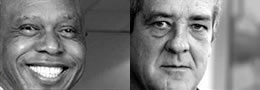
Tokyo Sexwale
Chairman
Glyn Lewis
Chief Executive
15 September 2006
![Northam Platinum [logo]](i/logo.gif)
