|
Safety
The excellent safety performances at Northam reported in the past
couple of years have been tragically marred by the death of eight
employees. This was particularly disappointing taking into account the
2 million fatality-free shift achievement in September 2002.
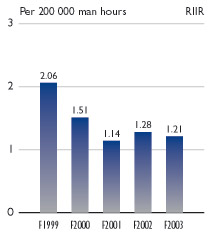
Of some relief were the improved statistics for the lost time
injury incidence rate and the reportable injury incidence rate
(measured per 200 000 man-hours) which dropped from 4.02 to 2.05 and
from 1.28 to 1.21 respectively. Also encouraging were the 1 million
fatality-free shifts achieved by one of the four underground managers
sections and the 2 million fatality-free shifts at the metallurgical
plants. Nevertheless, the overall performance is of serious concern to
management. Much work remains to be done to reduce the frequency and
severity of accidents and in further sensitising employees to hazards
in the workplace.
A number of safety initiatives have been introduced, among them
accident prevention videos, and a permanent communiciation centre
known as Radio Vuka, which provides for on-site presentations by team
leaders. Further behaviour-based safety campaigns will be initiated
during the new financial year to effect long-term attitudinal change
in the workplace.
Falls of ground (FOG) and tramming remain the most serious causes
of accidents. Although poor ground conditions have been the cause of a
number of the FOG accidents, we are intensively and continuously
monitoring our support standards. The principle of no work taking
place further than 1.5 metres from any support remains intact, and
will be more strictly enforced.
Safety targets for F2004 per 200 000 man hours:
| LTIIR: |
3.0 |
| RIIR: |
0.85 |
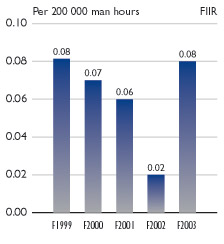
| FIIR: |
Nil |
Health
As anticipated, the results of the regular occupational health
screening have not indicated any negative trends in diseases
associated with platinum mining and smelting. This is largely
attributable to the continuing benefits associated with the hydropower
used underground, which largely eliminates noise in underground
working areas and further minimises the already low dust levels.
An exception to these trends was the increase in the number of
employees compensated for noise-induced hearing loss (NIHL), with 64
cases reported during the year largely as a result of previous
exposure to pneumatic machines on other mines.
| Number of
medical examinations performed |
|
Northam |
Contractors |
|
| Initial |
940 |
1 445 |
| Annual |
5 286 |
831 |
| Exit |
252 |
192 |
|
Tuberculosis continues to be on the increase, with a total of 139
cases reported during the year, probably reflecting the impact of HIV.
HIV positive patients who are being treated with prophylactic
antibiotics for secondary symptoms are also more prone to developing
multi-drug resistant tuberculosis. The medical department maintains
regular contact with patients, and counselling is provided for
patients who renege on their treatment.
Some progress has been made in the battle against HIV/AIDS.
Northam's efforts to contain the spread of the pandemic continue to
focus on three key areas:
- Peer education and awareness campaigns
- Controlling the incidence of sexually transmitted infections (STIs)
- Encouraging voluntary testing and counselling
The peer educator project continues, with a total of 38 peer
educators in three local villages and 24 on-mine educators. Further
training will continue, with the aim of increasing these numbers to 75
and 25 respectively by October 2003. Quarterly high-profile AIDS
awareness days are held on the mine, complemented by continuous
small-scale campaigns, which address issues such as life-threatening
diseases (including tuberculosis), the benefits of HIV testing, the
matter of confidentiality and disclosure and the promotion of a safer
workplace.
Treating sexually transmitted infections (STIs) is crucial to
containing the spread of HIV. On-mine statistics indicate a declining
trend in first-time STIs with the incidence of repeat infections
remaining constant. This pattern points to the difficulty in changing
sexual behaviour.
An AIDS coordinator has been appointed to assist with pre and
post-test counselling, and an AIDS committee has been established.
This has resulted in more people making use of the Voluntary
Counselling and Testing (VCT) programme and has led to the
establishment of a support group for those infected and affected by
the disease.
Plans are in place to conduct a Knowledge, Attitudes and Practice (KAP)
survey among the workforce to ascertain the effectiveness of the
company's prevention and education campaigns.
Environment
Northam Platinum is committed to ensuring that impacts on the
environment in which it operates are managed effectively to promote
sustainable development in the area where it operates. In order to
achieve this, the company's mandatory environmental management
programme is constantly reviewed in consultation with various
regulatory bodies.
The management of the environmental programme is enhanced by:
- Regular audits by independent specialists to ensure compliance
with both mandatory and self-regulatory requirements
- Quarterly surveys to monitor performance in key areas
- A continuing focus on advancing technology to address impacts
effectively
- Increasing awareness and knowledge of environmental requirements
Biodiversity
Northam's mining property lies adjacent to the Crocodile River to
the east, and the Bierspruit to the west. These rivers are an
important focus area of the mine's environmental monitoring systems.
Biomonitoring surveys are conducted at three pollution control dams on
the mine property as well as at points both up and downstream of the
Bierspruit and Crocodile River.
In order to determine the level of impairment of the water quality
in the rivers, the environmental department is currently compiling an
inventory of aquatic organisms. The biomonitoring survey can
determine, qualitatively, the level of impairment on water quality
based on the presence and abundance of these organisms. To date the
two rivers have indicated minimal adverse effects, although the
pollution control dams have shown rising salinity levels.
The layout of mining infrastructure was designed to minimise land
usage. A nature reserve, comprising 810ha, has been established on the
surrounding land to preserve the area's biodiversity; the balance is
used for farming purposes.
Alien invasive vegetation is sometimes a problem in areas where
soils have been disturbed. This alien vegetation is regularly removed
and the areas are treated with registered herbicides to prevent their
regrowth.
Water management
Northam's water management programme is based on the following
tenets:
- Ensuring compliance with relevant legislation including the
National Water Act, the National Environmental Act and the
Minerals Act
- Optimising the use of water from supply authorities to minimise
demand
- Recycling water for a number of uses and regular monitoring of
the quality of industrial water
- Preventing discharge of polluted industrial water into adjacent
receiving water bodies
Water consumption is monitored at each of the strategic consumer
points (shafts, processing plants, housing and amenities). For the
period under review the total water consumption was 15 058 megalitres,
of which only 3 816 megalitres were supplied by the Magalies Water
Board; the balance of 11 242 megalitres having been recycled.
Surface and industrial water
Northam makes use of three pollution control dams to contain
run-off water from the shaft and processing plants as well as fissure
water encountered in underground workings. The dams are lined with
clay to avoid seepage. Similarly, overflow in the rainy season is
avoided since the dams' design maximises the surface area of the
water, thereby promoting evaporation. Pumping facilities to route
water from these dams to a central dam near the concentrator plant
have been completed. The water is re-used in the plant.
Additional pumping facilities have been installed at the tailings
return water dam to ensure that no overflow runs into the Crocodile
River.
In order to comply with the provisions of the current water use
permits, and in preparation for applications for water user licences
in terms of the SA National Water Act, Northam is moving towards
quantifying waste loads (salt levels) of the surface and ground water
regimes. This will enable an assessment of the cumulative impact of
the operation on the downstream environment.
Ground water management
The mine's ground water monitoring programme has been boosted by an
additional 12 boreholes drilled during the first half of the year. The
first samples have been analysed and have been found to be of an
acceptable standard, with no evidence of heavy metal contamination,
and only slightly raised salinity levels attributable to the
hydrogeology of the region.
Air
quality management
|
| Emissions |
Management control
mechanisms |
|
| Sulphur dioxide
(SO2) and particulates
(dust) from the smelter
processes |
15 monitoring stations are
situated on and around the property to determine the potential impact of
emissions. Current readings of SO2 are 20
times lower than the threshold of 50
parts per billion (ppb). Dust emissions have been eliminated
since the installation of a wet scrubber downstream of the
electrostatic precipitator. |
|
| Particulates from
tailings dams,
transportation and materials handling |
The tailings have been
largely grassed and covered by natural vegetation, resulting in minimal dust
levels. |
|
| Carbon dioxide |
The use of vehicles is
restricted to a very small fleet of transport vehicles. Ore is
hauled either by battery or electrically-driven transport. |
|
| Ozone-depleting
substances (CFCs) |
Two refrigeration machines have been
converted to the acceptable R134a refrigerant. Extensions to
the refrigeration plant will also comply with this standard.
During the year four tonnes of CFCs were contained and disposed
of. Their transportation is being monitored by the United
States' Environmental Protection Agency. |
|

Glyn Lewis
General Manager
12 September 2003
|