![Go to home page [Northam logo]](images/logo.png)


OPERATIONS REVIEW

Zondereinde mine – key facts and statistics
- Ownership
- Wholly-owned by Northam Platinum Limited
- Location
- Northern part of the western limb of the Bushveld Complex in Limpopo province; adjacent to the Anglo Platinum’s Amandelbult operation
- Access and infrastructure
- Well-established infrastructure: tarred roads, railway, water and power
- Project extent
- 7 625 hectares; strike length of 8km
- Reserves
- 8.15Moz (3PGE+Au)
- Resources
- 82.92Moz (3PGE+Au)
- Life of mine
- 18 years
- Operations
- Underground mining operations on the Merensky and UG2 reefs between 1 200 and 2 200 metres in depth
- Underground equipment driven by hydropower
- Surface operations include a Merensky and UG2 concentrator plant, a smelter and base metals removal plant (BMR)
- Production profile
- Steady state output of approximately 300 000oz (3PGE+Au) annually
- Precious metals refining Performed by WC Heraeus GmbH (Heraeus) in terms of toll-treating agreement
- Marketing
- In-house, independent marketing to established global customer base
- F2011 capex
- R287 million
- F2012 capex (estimate)
- R384 million
- F2011 cash costs
- R279 118/kg (3PGE+Au)
People, health and safety
At the end of June F2011, a total of 9 042 people were employed at the Zondereinde mine (6 851 permanent employees, 1 504 long-term contractors and 687 short-term contractors). In spite of the pressure on production, and the disappointing operational performance, no employees lost their jobs owing to any organisationsal resturcuturing or retrenchments during the year.
Maintaining the company’s BEE credentials in the year was marked by progress in employing and developing historically disadvantaged South Africans (HDSAs). At the end of F2011, 45% of management positions were filled by HDSAs (F2010: 32%) with women making up 7% of the workforce compared with 6% during F2010.
Ensuring the safety of employees and contractors is a primary area of focus for the company and takes precedence over any production objectives. A critical objective has been to develop and instill a shared duty of care between employees at all levels in the company. The safety performance over the year was disappointing.
Key indicators
Safety
- Five fatalities (F2010: one)
- LTIIR1 – 1.34 per 200 000 hours (F2010: 0.83)
- RIIR2 – 0.83 per 200 000 hours (F2010: 0.52)
- FIIR3 – per 200 000 hours (F2010: 0.01)
- 4 234 shifts lost owing to occupational injury (F2010: 1 881)
Community and environment
- Water used – 4 832m²
- Water recycled – 90%
- Energy usage – 601 890MWh
- Energy saved – MWh
- SO2 emissions – 6 374 tonnes
- CO2e emission – 635 401 tonnes
- Environmental liability of R million
- Corporate social investment of R million
- 1 LTIIR – lost time injury incidence rate – resulting in one to 13 days’ absence from work
- 2 RIIR – reportable injury incidence rate – resulting in 14 or more days’ absence from work
- 3 FIIR – fatal injury incidence rate
Zondereinde operating statistics
| F2011 | F2010 | |
|---|---|---|
Merensky reef |
||
| Development metres | 5 899 | 8 864 |
| Square metres mined | 140 501 | 201 569 |
| Tonnes milled | 793 490 | 1 002 208 |
| Head grade (g/t 3PGE+Au) | 5.6 | 5.9 |
| PGMs in concentrate produced (kg) | 3 792 | 5 094 |
| Ore reserve availability (months) | 18 | 20 |
UG2 reef |
||
| Development metres | 1 720 | 2 694 |
| Square metres mined | 125 726 | 166 129 |
| Tonnes milled | 797 355 | 1 036 017 |
| Head grade (g/t 3PGE+Au) | 4.3 | 4.6 |
| PGMs in concentrate produced (kg) | 2 882 | 3 917 |
| Ore reserve availability (months) | 24 | 24 |
Combined reefs |
||
| Development metres | 7 619 | 11 558 |
| Square metres mined | 266 227 | 367 698 |
| Tonnes milled | 1 590 845 | 2 038 225 |
| Head grade (g/t 3PGE+Au) | 4.9 | 5.2 |
| PGMs in concentrate produced from u/g mining (kg) | 6 674 | 9.011 |
| PGMs in concentrate from other sources (kg) | 1 105 | 988 |
| Total (kg) | 7 779 | 9 999 |
| PGMs in concentrate purchased | 2 240 | 2 106 |
The year in review – mining and production
The six-week strike in September/October 2010 had a predictably adverse effect on production results.
In total 65 out of 301 working days available for mining were lost due to strike action and safety-related incidents. A total of 1 590 845 tonnes were milled (F2010: 2 038 225), illustrating the effects of stoppages, but also of the anticipated constraints on the Merensky horizon and ore reserve position. The combined grade at 4.9/t (MR: 5.6g/t; UG2: 4.3g/t) was 5.8% lower year-on-year owing to some unavoidable waste mining, mining the normal reef at a higher average stoping width in order to maximise metal extraction, the incidence of transition zone intersections and poor control of the UG2 reef.
On the Merensky reef the grade reflected the incidence of a higher average stoping width on the normal reef in order to maximise metal extraction; the incidence of transition zone intersections; and ground conditions.
Going forward this will be addressed through a tighter focus on mining width and grade control.
Metals in concentrate produced declined by 22.2% to 7 779kg (250 110oz), due largely to the loss of operating shifts. Purchased concentrate amounted to 2 244kg (72 146oz).
The key to recovery at Zondereinde lies in the availability of the Merensky reef. Some progress has been made in this area, but some challenges remain:
- The 14 level development has intersected the Little John Dyke on the eastern side of the mine, and sealing is in progress. With high ground water yields delays are anticipated until at least the end of Q1 of F2012.
- On the western side of the mine, at year-end, the 3, 4 and 12 levels were on short rounds owing to adverse ground conditions. In traversing the 14 line fault, delays on both 3 and 4 levels have affected the establishment of footwall drives and crosscuts. On 3 level significant ground consolidation has been required ahead of development.
- Operations on the 1, 5, 6, 13 and 14 levels were temporarily halted to enable ring covering and sealing.
- The lag on 6 and 7 levels has precluded connectivity between the upper and lower levels. This will remain so until raise connections hole between 8 and 5 levels. On 1 and 13 levels sealing work has advanced well, and the fissure appears to be less problematic on these two levels than on others.
- The deepening project has progressed, despite the slow introduction in the first half of the year of the new mechanised equipment. These problems have been largely overcome and the benefits of the larger equipment on the development cycle were evident in the second half of the year. In addition, increased volumes of normal reef are being mined from this area. Mining options remained limited, particularly in the second half of the year. These conditions are likely to persist for the next 18 months until the additional stoping areas in the upper and central western portions of the mine, together with the decline section, come on stream.
Metallurgical operations
Since the repairs to the electrostatic precipitator, completed in October last year, the metallurgical operations continued to operate satisfactorily during the year. Work continues on assessing future smelting options.
Costs and capital expenditure
The combination of lower production volumes and higher mining costs resulted in unit cash cost increases of 29.3% to R279 118/kg compared to R215 900/kg in the previous comparable reporting period. Capital expenditure at Zondereinde absorbed R268.9 million (F2010: R231.5 million), with the major capital expenditure item being the deepening project, within budget at R92.7 million. Capital expenditure for F2012 is likely to be approximately R384.3 million with the deepening project and the accelerated development accounting for about R179.7 million.
Township land and development
In terms of the group’s strategy of assisting employees to acquire affordable housing, management is pleased to advise that 100 houses were sold in the Mojuteng Township of Northam town during the reporting period.
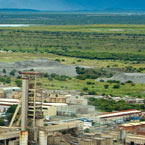
Metallurgical processing plant at Zondereinde
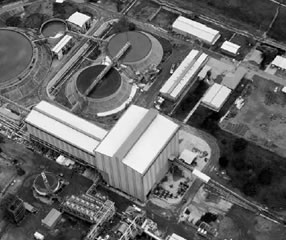
Aerial view of the Zondereinde concentrator plants