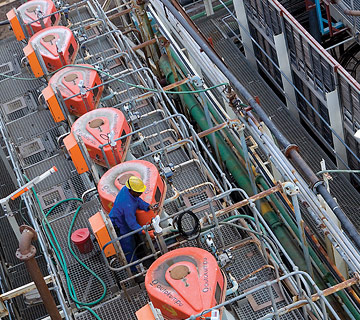
Underground mining activities focus on the Merensky and UG2 reefs at an average depth of 1 750m. Hydropowered equipment is used in stoping and development. Surface infrastructure includes concentrators for Merensky and UG2, a base metals removal plant and a smelter. Marketing and sales to customers in North America, Japan and Europe is conducted in-house.
The mechanised room and pillar underground workings are accessed via a cluster of four declines (three on reef and one in the footwall), as well as a reverse decline system. Surface metallurgical infrastructure includes a UG2 concentrator and a dense media separation plant as well as a chrome spirals plant. Concentrate is smelted at Zondereinde.
Crushing/screening circuit: In the crushing/screening circuit the ore is crushed to reduce its size before it reports into the mill.
Milling: Merensky ore feeds into a fully autogenous (FAG) mill. In the UG2 plant, the crushed product feeds into a high pressure grinding roll and then into a primary ball mill.
Flotation: The circuit includes rougher cells, scavenger cells and cleaner columns. External sparger column cells act as a cleaner and help to produce a final UG2 concentrate with significantly lower chrome content while maintaining PGM recoveries.
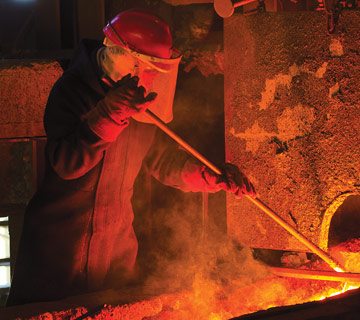
Commissioned in 1993, the smelter has a 15MW capacity. Key processes include drying, smelting and converting the concentrate. Concentrate brought in is blended and dried concentrate is pulverized and then stored in silos. Off-gases are cleaned in an electrostatic precipitator. Concentrate and flue dust is mixed with lime and then fed through to the day bin and into the furnace where electrodes provide heat. The lighter oxides float to the top as slag and the more dense sulphides, which contain the PGMs, sink to the hearth as furnace matte.
Looking beyond the prevailing operational landscape, Northam seeks to harness the inherent potential for growth of its production profile, and to optimise its current infrastructure, thereby maximising value delivered to all stakeholders.
Northam’s current business relies primarily its two primary operating assets – the Zondereinde and Booysendal PGM mines, and its own metallurgical operations, including a base metals removal plant and smelter, located on the Zondereinde lease area.
Incorporating a metallurgical complex, comprising a smelter and a base-metal removal plant, Zondereinde is a deep-level conventional mining operation producing approximately 300 000oz of PGM per annum.
Zondereinde is the world’s deepest platinum mine and the complex geology is characterised by potholed reef and frequent fault structures. Ore grades are relatively high at Zondereinde, as are the metallurgical recoveries from both the Merensky and UG2 ore, which is mined concurrently from the same infrastructure. The mine’s resource is estimated at 80.1Moz, and the life of mine currently stands at 15 years.
To extend the life of mine, a deepening project is underway. The development of infrastructure which includes a conveyor decline, a chairlift and a material decline from 13 level to 18 level, has reached 16 level at a depth of 2 300m below surface, and has been equipped to 15 level.
The Booysendal North mine is a relatively shallow, fully mechanised UG2 mining operation, with a resource of 6.4Moz. The current life of mine is 20+ years. The total Booysendal resource is in excess of 100Moz and with the development of additional mining modules could support mining operations for 50+ years.
The Booysendal North mine has been developed as a room and pillar operation.
The main underground infrastructure consists of the following key elements:
Independent of the major South African platinum producers, Northam’s metal is toll-refined in terms of a long-standing contract with Heraeus PGM concentrate is delivered on a weekly basis to the Heraeus refinery in Hanau near Frankfurt, Germany.
Since 1992, Northam’s entire production of metal, has been refined in Hanau. Latterly some of Northam’s material has also been treated at the Heraeus plant in Port Elizabeth in South Africa.
A registered member of the London Platinum and Palladium Market (LPPM), Heraeus has London-Zurich ‘Good Delivery’ status for metal production. The refinery in Hanau is subject to strict European Union and materials handling protocols. Product transportation is also strictly defined by international aviation regulations.
All health and safety impacts of the final product in the various stages of production are assessed, and health and safety issues relating to the final product are addressed continuously.
Customers are assured that there are no material health and safety complications related to the final products produced and sold by Northam with the exception of nickel sulphate, which is managed as a hazardous material and accompanied by relevant safety and health documentation.
There were no incidents of non-compliance with voluntary codes concerning the health and safety of products and services in F2014.
No safety, health or environmental labelling is required for pure PGMs, however, requirements exist for the base metal by-products entering Northam’s marketing and sales stream. Specifically, the transportation and distribution of nickel sulphate is strictly regulated – it is transported as hazardous material and accompanied by appropriate coding and labelling along with relevant safety data sheets informing transporters, handlers and customers.
Northam, as a regulated agent, complies with South African Civil Aviation Authority regulations, which govern export of the company’s products. All containers used in the exportation process – from mine to market – are accompanied by documentation validating the contents of each shipment.
No incidents of non-compliance with regulations and voluntary codes were reported in F2014 relating to product and service information and labelling.
Northam’s marketing department maintains regular weekly contact with its domestic and international customers, and hosts customer meetings and undertakes visits to customer facilities. Customer representatives undertake reciprocal visits to Northam’s mining and metallurgical operations.
Any issues relating to customer satisfaction are taken up directly with the marketing department and addressed proactively. Any problems can thus be addressed timeously and resolved satisfactorily, and customer feedback receives immediate attention.
Due to the nature of Northam’s long-standing relationships, frequent face-to-face interaction with its customers and proactive redress of any issues arising, and additional customer satisfaction surveys are not required.
As the sale of Northam’s products is largely conducted on a business-to-business basis for industrial applications, no definitive codes are followed for the purposes of marketing communications, promotions and sponsorships. As a result, no incidents of non-compliance with regulations or voluntary codes concerning marketing communication, advertising or promotion on sponsorship were reported during F2014.
During F2014, no fines were received in respect of non-compliance in the process of the provision and use of Northam’s product.
Northam respects the privacy of its customers and, to this end, confidentiality agreements and nondisclosure undertakings are standard in its customer contracts. No complaints, substantiated or otherwise, regarding breaches of customer privacy and losses of customer data occurred during the year under review.